
For more than a decade, I have spent a significant portion of every summer living outside the United States. These temporary relocations prompt me to reassess practices that I had long taken for granted—from workplace norms to social policy, parenting to holiday traditions.
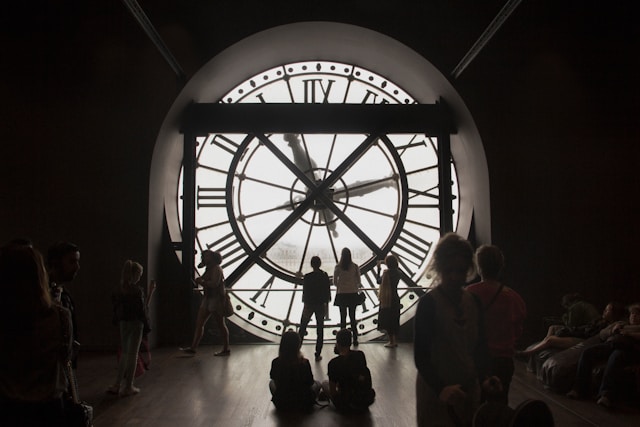
My most recent cross-cultural preoccupation has been with time: How do we experience time individually and collectively?
This might seem like a purely philosophical question, but our ability to organize and control time has a lasting impact on how we create community, develop a shared mission, and ultimately how we work together toward common goals.
A collective sense of time is necessary to sustaining the work any mission-driven organization, from schools and universities to policy bodies, grassroots community groups, nonprofits, and NGOs. In an age in which we take for granted remote work and asynchronous organizing through Slack and Signal, we ignore the power of shared time at our peril.
From the passeggiata and the Mittagspause to personal Tetris
I have long observed that Germany and Italy have communal rhythms and routines that bring people together, often in a casual and unplanned manner. In virtually every Italian town and village I’ve visited, for example, the evening passeggiata brings people of all generations to the town square or main street to stroll, socialize, and enjoy a gelato or drink.
When I worked in Germany, workplace norms dictated that we ate lunch together every day. (It helped to have an onsite cafeteria). The six-week summer holiday is the same within each federal state (and staggered across the country): if you are on vacation, odds are that your friends, neighbors, and café owner are as well.
These shared rhythms make it easier to socialize, collaborate, and participate in civic life. Even though I worked roughly the same number of hours in Germany and the United States, I spent more time with friends and colleagues when I lived in Berlin.
By contrast, my American life is a Tetris-like puzzle of appointments and commitments. That Tetris matrix is mine alone, and each one of my friends, colleagues, and collaborators has their own matrix to manage.
The loneliness of the digital nomad
The erosion of our collective sense of time has been so gradual that I struggled to recognize it. It wasn’t until reading Oliver Burkeman’s Four Thousand Weeks: Time Management for Mortals, that I had a name and a framework for what I had been experiencing. (I have previously written about one of his other books here.)
In a chapter entitled “The loneliness of the digital nomad,” Burkeman eloquently describes the present-day decline of shared time:
What kind of freedom do we really want when it comes to time? On the one hand, there’s the culturally celebrated goal of individual time sovereignty—the freedom to set your own schedule, to make your own choices, to be free from other people’s intrusions… On the other hand, there’s the profound sense of meaning that comes from being willing to fall in with the rhythms of the rest of the world: to be free to engage in all the worthwhile collaborative endeavors that require at least some sacrifice of your sole control over what you do and when.
I have mixed feelings about Burkeman’s particular focus on the negative impact of remote and asynchronous work. As a whole, the opportunities opened up by telecommuting and flexible scheduling by far outweigh the disadvantages, especially for anyone juggling professional commitments with care work. (In other words, most of us, at some point in our lives.)
Furthermore, the shift to remote work is only part of a much longer story of individualization of time. The availability of on-demand TV and film means that we are less likely to share these forms of entertainment together. Music has increasingly become a private experience, consumed at will on streaming platforms through earbuds. Globalization and the 24-hour news cycle allow us to experience multiple time zones simultaneously.
What this means for your organization
This decline of communal time doesn’t simply affect our ability to get together with friends. It also makes the work of any community group or mission-driven organization considerably more difficult to carry out. Finding time for collaborative endeavors has become increasingly difficult—not necessarily because no one has any free time, but because the time available rarely overlaps. And in my experience, the more diverse the organization, the harder it is to find times in which all can gather together.
This loss is not inevitable. There are steps we can take to redefine and reinforce our sense of community time—not by reverting to rigid 9–5 workplace schedules, but in a manner appropriate to our current social and political moment. In my next newsletter, I’ll explore some of these possibilities.
Copyright 2023 Intellerate Consulting. All rights reserved.
Copyright 2023 Intellerate Consulting. All rights reserved.
Copyright 2023 Intellerate Consulting. All rights reserved.

