
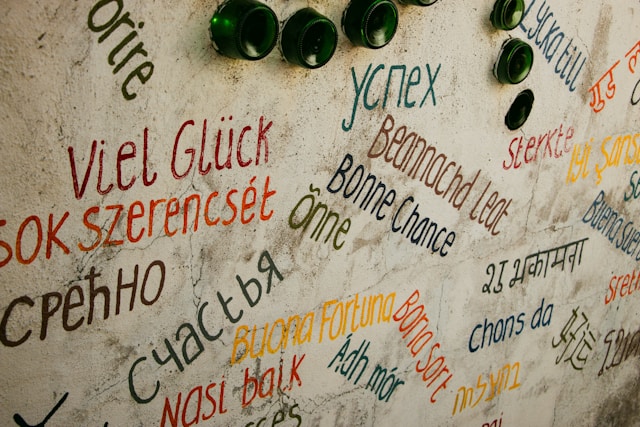
If you spend a lot of time writing, you know that adjusting your text for a new audience can be daunting. In many cases, it does not simply involve surface-level corrections, but instead requires something closer to a wholesale rewrite.
You might be a scientific researcher trying to convey your ideas to a nonspecialist public, a nonprofit making your case to an external grant agency, or—as is increasingly common in today’s global environment—a professional preparing materials for clients in another country, possibly even in another language, with differing assumptions about how the world works and how to communicate.
In this week’s newsletter, I’d like to introduce a concept that I’ve found useful for thinking about this kind of writing: transcreation. The idea comes from the world of global marketing firms, but I find it offers a framework for anyone who writes across cultural or contextual boundaries. And, as I’ll describe, it is an approach that should be part of the toolkit of any mission-driven organization, even if you never leave your own country or language.
The technology was the easy part
My biggest administrative project this spring has been the development and launch of a German version of my website. Roughly half of my projects are based in Germany, so this was long overdue.
From a technological standpoint, the process was relatively straightforward. Thanks to a WordPress plugin, website visitors can now easily toggle between languages.
But from a marketing perspective, I quickly recognized that it would be a mistake to rely on the plug-in’s AI-supported automated translation. My reservations had little to do with the accuracy of the translation engine; in recent years, machine-generated translations have become astonishingly good.
My main concerns related to culture and context.
My German clients—mostly from the higher education and research sectors—have different needs, challenges, experiences, and biases from my American clients. This German audience tends to be more formal, more tolerant of complexity, and more averse to superficiality and overt market-speak. Ultimately, I enlisted a colleague to help with a more thorough German rewrite. The result wasn’t simply a translation, but a reframing.
More than translation
The kind of professional (and, I’ll say it, human) support I needed for my website is akin to the work I do for my German clients: I begin with their German text (or a text that is a mixture of German and English), and transform it into an English document reframed for an international readership.
Some of this work takes place at the level of the word: terms that are commonly known in the German higher education context, such as Reformuniversität or außeruniversitäre Forschungseinrichtung cannot simply be rendered directly into English as “Reform University” or “non-university research institution.” They require explanation that is clear, direct, and—in the case of longer documents—repeated.
Other times, concepts that appear equivalent across languages mean very different things in practice. For example, when I encounter the word “diversity” in the US higher education context, I usually first think of racial and ethnic diversity. During my time living and working in Germany, I found that diversity discourse has centered principally on gender—ensuring equitable opportunities for women in research and leadership; race and ethnicity, though not absent, are often discussed through a different frame, often that of migration background.
Neither framing is wrong. But they are not the same thing, and assuming otherwise leads to misunderstanding, particularly if one is describing their institution’s diversity policies to an international audience. And the discourse continues to change in both countries, making it all the more important to stay current on how these terms are actually being used.
The trickiest aspect of transcreation, however, involves bringing to light those concepts, ideas, or biases that are usually left unsaid in the original language. Gender equality is a useful example here, too. In Germany, gender quotas and parity targets—for corporate boards, academic hiring committees, and increasingly political parties—are a widespread, if still debated, feature of professional life. For most German readers, this is familiar ground. Many American readers, by contrast, would do more than pause; they’d be surprised, perhaps unsettled, to find such mechanisms treated as unremarkable.
That gap in expectation is precisely what needs navigating. In these and similar scenarios, it is my job to flag these potential points of friction and determine how best to finesse them for the intended reader.
Not only a multilingual challenge
Transcreation isn’t only relevant to those of us working across national or linguistic borders. Most grant proposals and annual reports require the same careful consideration of the intended readers: What do they already know? What do they care about? What assumptions are embedded in my text that I haven’t thought to question?
The questions apply whenever you’re writing across a meaningful divide, whether that divide is national, disciplinary, organizational, political, or cultural.
In my next newsletter, I’ll lay out four principles of effective transcreation and offer practical guidance that I’ve found useful whether the project involves two languages or just one. And I’ll also raise a harder question: as AI tools make translation faster and easier, and as technology makes it ever easier for us to collaborate across national borders while staying at home, what are we at risk of losing?
Copyright 2023 Intellerate Consulting. All rights reserved.

